
Introduction
Automation has become an essential part of modern business operations. From managing repetitive tasks to improving productivity, automation technologies have helped companies reduce costs and increase efficiency. However, a new innovation is now transforming the way automation works: AI agents.
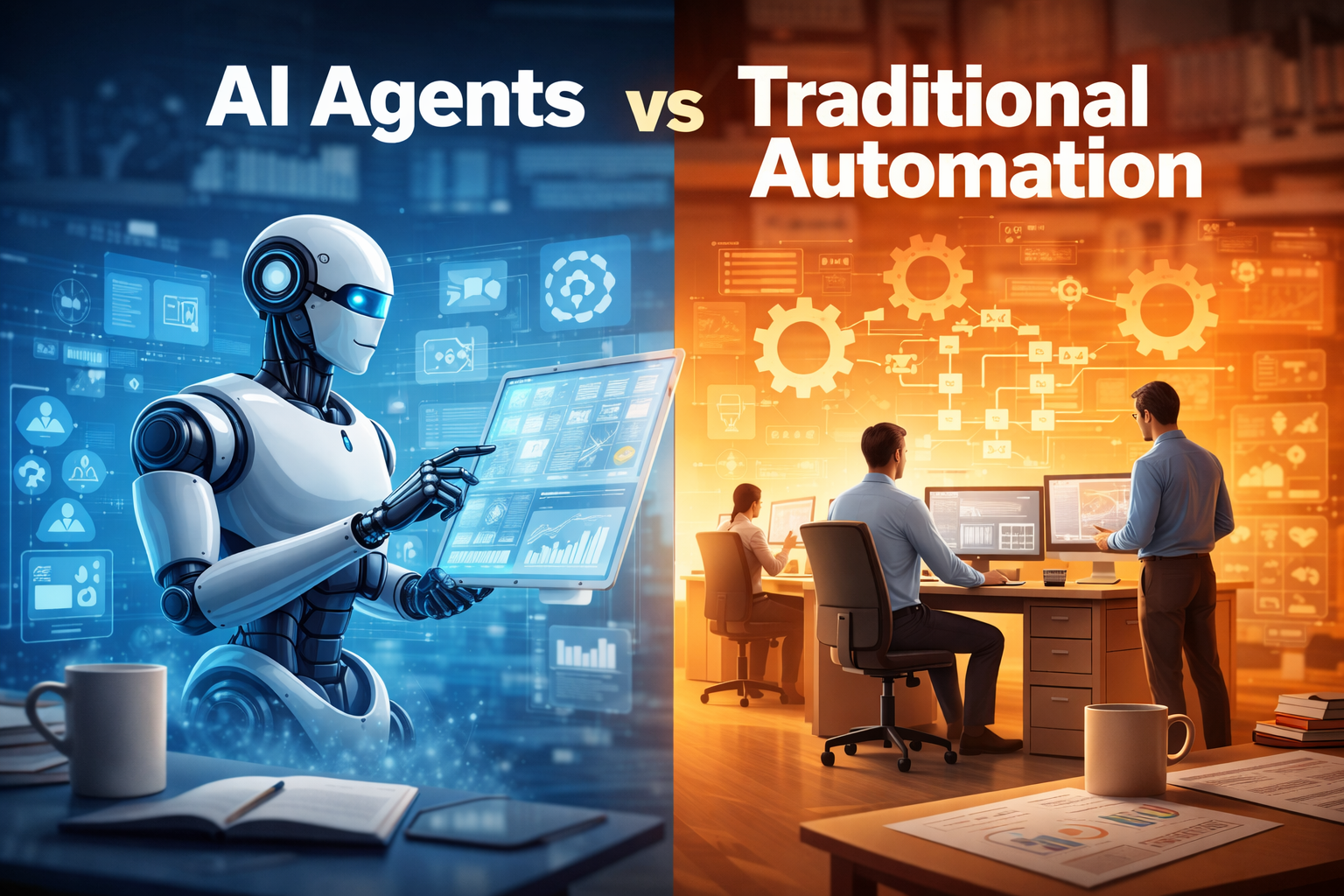
While traditional automation relies on predefined rules and workflows, AI agents bring intelligence, adaptability, and decision-making capabilities to automated systems. Understanding the difference between these two technologies can help businesses choose the right solution for their future growth.
What Is Traditional Automation?
Traditional automation refers to systems designed to perform tasks based on fixed rules or predefined instructions. These tools follow structured workflows and repeat the same process every time the conditions are met.
For example, a traditional automation system may automatically send an email notification when a customer submits a form or update records in a database when a purchase is completed.
Traditional automation is effective for repetitive and predictable tasks but lacks flexibility when dealing with complex or dynamic situations.
Common Examples of Traditional Automation
- Email marketing workflows
- Data entry automation
- Order processing systems
- Customer onboarding workflows
- Scheduled reporting tools
These systems operate based on if-then logic, meaning they require manual configuration and cannot learn from new situations.
What Are AI Agents?
AI agents are intelligent systems powered by artificial intelligence and machine learning that can analyze data, make decisions, and perform tasks autonomously.
Unlike traditional automation tools, AI agents can understand context, learn from interactions, and adapt their behavior over time. This allows them to handle more complex tasks that require decision-making and problem solving.
For example, an AI agent can analyze customer queries, determine the intent behind them, and respond with personalized solutions without human intervention.
Examples of AI Agents in Business
- AI customer support assistants
- Smart recommendation engines
- Predictive analytics systems
- AI sales assistants
- Intelligent chatbots
These technologies allow businesses to automate not just tasks, but entire decision-making processes.
Key Differences Between AI Agents and Traditional Automation
1. Intelligence and Learning
Traditional automation follows fixed rules and cannot learn from new data. AI agents, on the other hand, use machine learning to continuously improve their performance.
2. Adaptability
Traditional systems struggle when faced with unexpected situations. AI agents can adapt to new scenarios by analyzing patterns and adjusting their responses accordingly.
3. Decision-Making Capabilities
Traditional automation performs predefined actions, while AI agents can evaluate multiple variables and make informed decisions.
4. Scalability
AI agents are highly scalable and can manage complex workflows across multiple systems, making them ideal for growing businesses.
Benefits of AI Agents for Businesses
Enhanced Productivity
AI agents can perform multiple tasks simultaneously, allowing businesses to automate complex operations more efficiently.
Improved Customer Experience
AI-powered assistants can provide instant responses, personalized recommendations, and 24/7 support to customers.
Data-Driven Insights
AI agents analyze large amounts of data to uncover valuable insights that help businesses improve their strategies.
Reduced Operational Costs
By automating decision-making processes, companies can reduce manual labor and operational expenses.
When Businesses Should Use Traditional Automation
Despite the advantages of AI agents, traditional automation still has its place in business operations. For simple and repetitive tasks, rule-based automation remains cost-effective and reliable.
Businesses often combine both approaches to create hybrid automation systems that maximize efficiency.
The Future of Business Automation
The future of automation lies in intelligent systems that combine traditional workflows with artificial intelligence. AI agents will continue to evolve, enabling businesses to automate complex tasks, analyze data in real time, and improve decision-making processes.
Companies that adopt intelligent automation early will gain a significant competitive advantage in their industries.
Conclusion
Both AI agents and traditional automation play important roles in modern business operations. While traditional automation is ideal for predictable tasks, AI agents offer advanced capabilities such as learning, adaptability, and intelligent decision making.
Businesses looking to scale and innovate should explore how AI-powered automation solutions can transform their operations and drive long-term growth.